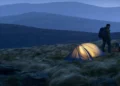
Wild camping is legal across much of Scotland when done responsibly, but the rules change sharply once you cross the border. In England, Wales and Northern Ireland, there is no general right to pitch a tent on someone else’s land without permission — although Dartmoor is an important exception and some responsible wild camping is tolerated elsewhere.
That distinction matters more than ever as wild camping has become a staple of hiking videos, weekend micro-adventures and social media feeds. A remote patch of grass might look like fair game at sunset, but owning a lightweight tent and walking several miles into the hills doesn’t automatically give you the right to sleep there.
The good news is that legal wild camping in the UK isn’t difficult once you understand where the lines are drawn.
Scotland offers by far the broadest access rights. England and Wales generally require the landowner’s permission, with a specific statutory right for backpack camping on parts of Dartmoor. Northern Ireland also has no Scotland-style right to roam: most countryside is privately owned and access largely depends on public rights of way or the landowner’s agreement.
Here’s what you need to know before strapping a tent to your rucksack.
The Golden Rule: The Absolute Law in Scotland
If you want the simplest answer to “where can I legally wild camp in the UK?”, Scotland is the obvious place to start.
The Land Reform (Scotland) Act 2003 established statutory access rights over most land and inland water for recreational purposes. Those rights include responsible, lightweight wild camping where access rights apply.
That doesn’t mean you can pitch absolutely anywhere.
The Scottish Outdoor Access Code says wild camping should involve small numbers of people, lightweight tents and usually no more than two or three nights in one place. Campers should stay well away from buildings and roads, avoid enclosed fields containing crops or livestock and leave no trace behind.
Access rights also don’t normally cover places such as private gardens, the immediate surroundings of houses, school grounds, buildings and certain land where crops are growing. In other words, “wild camping is legal in Scotland” does not translate to “every square metre of Scotland is a campsite”.
The basic deal is remarkably straightforward: Scotland gives you substantial freedom to explore, provided you exercise that freedom responsibly.
There are local restrictions to watch for.
The best-known example is Loch Lomond & The Trossachs National Park, where Camping Management Byelaws operate in designated lochside zones from 1 March to 30 September each year. During that period, camping inside those zones requires either a booked camping permit or a pitch at a designated campsite. Outside the management zones, normal Scottish access rights continue to apply.
So even in Scotland, check local restrictions before setting off. National parks, nature reserves, estates and areas facing a high wildfire risk can have additional rules or temporary controls.
The Reality Check: Wild Camping in England and Wales
England and Wales work very differently.
Having a legal right to walk across land does not automatically give you a legal right to camp on it.
Large areas of mountain, moor, heath, down and common land are covered by public access rights, but those rights principally allow recreation such as walking rather than giving people carte blanche to spend the night.
Eryri National Park makes the position particularly clear: wild camping is not permitted without prior permission from the landowner or farmer, including on land classed as open country under the Countryside and Rights of Way Act.
Pitching without permission will generally put you in civil trespass territory rather than making ordinary one-night backpack camping a criminal offence in itself. That distinction is worth understanding.
A landowner or their representative can ask you to leave. If that happens, the sensible response is simple: pack up and move on.
Other behaviour can create much more serious problems. Damaging property, refusing certain lawful directions, lighting fires where prohibited, causing significant disruption or engaging in aggravated trespass can bring separate legal consequences.
What happened to wild camping on Dartmoor?
Dartmoor is the big exception — and the law here has been through a remarkable few years.
For decades, lightweight backpack camping took place on parts of Dartmoor under an assumed right of access. That position was challenged by landowners Alexander and Diana Darwall.
In January 2023, the High Court ruled that the Dartmoor Commons Act 1985 did not provide a public right to camp.
The Court of Appeal subsequently overturned that decision.
Then, on 21 May 2025, the UK Supreme Court unanimously dismissed the landowners’ appeal. It ruled that the right of public access for “open-air recreation” under section 10(1) of the Dartmoor Commons Act 1985 includes wild camping.
That makes Dartmoor genuinely different from the rest of England.
But it still isn’t an invitation to throw a tent down anywhere inside the National Park.
Dartmoor National Park Authority currently says backpack camping is permitted on some of Dartmoor’s commons and directs campers to its interactive camping map before every trip. The map identifies where you can backpack camp without seeking prior approval from the landowner.
The Authority’s rules are also much closer to traditional backpacking than campsite-style camping.
You should:
- carry your camping equipment as part of your walk;
- use a small, lightweight tent;
- camp for only one or two nights;
- stay out of sight of roads and settlements;
- avoid large groups;
- light no open fires or barbecues; and
- take everything away with you.
Dartmoor’s published camping data was updated in June 2026, so don’t rely on an old screenshot or a map saved from somebody’s blog. Check the live Dartmoor camping map when planning your route.
There are other practical hazards too. Some camping areas overlap with military training land, where access can be restricted during live firing, while additional care is requested during the ground-nesting bird season.
What about the Lake District?
Wild camping in the Lake District occupies a strange middle ground between the written rule and long-standing practice.
Legally, the National Park says wild camping is not permitted without the landowner’s permission.
In practice, the Lake District National Park Authority openly acknowledges that lightweight wild camping is normally tolerated when people camp responsibly: above the highest fell wall, well away from towns, villages and lake shores, for one night, with only one or two unobtrusive tents.
That is tolerance, not a legal right.
A landowner can still tell you to leave.
Camping beside a lake, pitching next to your car, taking over a lay-by with a large tent or setting up chairs and a barbecue isn’t the same thing. That’s generally described as fly camping, and it is precisely the behaviour that has prompted tighter enforcement in popular areas.
Traditional Lake District wild camping is better understood as: walk high, pitch small, arrive late, sleep, leave early and make it impossible to tell you were ever there.
And Eryri – formerly Snowdonia?
The position in Eryri National Park is less ambiguous.
The National Park Authority states that wild camping is not permitted without prior permission from the landowner or farmer. Being high in the mountains or on open-access land does not remove that requirement.
Its own wild camping code nevertheless gives useful guidance for people who have obtained permission: camp high and away from houses and farms, pitch late, leave early, stay for one night and keep the site quiet.
That’s a good blueprint anywhere in the UK.
Just don’t confuse good camping etiquette with legal permission.
Essential Beginner Rules for “Leave No Trace”
Being allowed to camp somewhere is only half the job.
The unwritten agreement behind wild camping is that a small tent appearing for one night should have virtually no effect on the land, wildlife or people who live nearby.
If you’re new to it, these three rules cover most of what matters.
Arrive Late, Leave Early
You’re camping, not claiming a plot.
Aim to pitch towards the end of the day and be packed away early the following morning. Don’t occupy the same spot for several nights unless the local rules specifically allow it.
Choose a location away from houses, farms, roads, busy paths and livestock. Keep groups small and your tent discreet.
This isn’t about trying to hide from landowners. It’s about reducing your impact on everyone else using or working on the land.
In places such as the Lake District, the National Park’s own guidance recommends one-night stays above the highest fell wall, away from settlements and lake shores. Dartmoor similarly expects backpack campers to stay out of sight of roads and buildings.
If someone with authority over the land asks you to move, don’t turn it into an argument. Pack your tent and go.
No Campfires Under Any Circumstances
For a beginner, the safest rule is simple: don’t light a campfire when wild camping.
Carry a proper camping stove instead.
A tiny fire scar can remain visible long after you’ve gone, while peat, dry grass and moorland vegetation can ignite far more easily than people expect.
On Dartmoor, open fires and barbecues are prohibited for backpack campers. The Lake District tells wild campers not to light fires at all.
Scotland doesn’t have one blanket nationwide rule banning every outdoor fire in every circumstance, but the Scottish Outdoor Access Code strongly promotes stove use and warns against fires during dry conditions or near forests, moorland, farmland, buildings and historic sites. Local restrictions can be stricter.
For a first wild camp, there’s little reason to complicate matters. Take a gas stove, keep it stable and well away from flammable vegetation, and check for any wildfire restrictions before your trip.
Leave the Site Cleaner Than You Found It
Everything you carry in should leave with you.
That means obvious rubbish such as food packets and bottles, but also tissues, wipes, food scraps, tea bags and anything else that doesn’t belong on the hillside.
Don’t assume something being biodegradable makes it acceptable to dump.
Human waste needs more thought. The correct method varies according to the landscape and local guidance. Dartmoor’s code currently tells backpack campers to bury faeces and toilet paper beneath at least 15cm of turf, away from water. Scotland’s Outdoor Access Code also advises carrying a trowel and burying human waste while keeping well away from burns, rivers and open water.
In particularly sensitive, rocky or heavily used areas, packing waste out may be the better option. Sanitary products and wipes should always be carried out rather than buried.
Don’t dig drainage channels around your tent. Don’t move rocks to build furniture. Don’t cut vegetation for bedding. Don’t leave stones arranged around your pitch.
When your rucksack goes back on in the morning, the ground should look as though nobody slept there.
The Verdict: How to Plan Your First Legal Pitch
The easiest first wild camping trip isn’t the one where you spend the evening wondering whether an angry farmer is about to appear.
Make legality part of the route planning.
If you’re in Scotland, check that access rights apply where you intend to camp, follow the Scottish Outdoor Access Code and look for any local restrictions or seasonal byelaws.
If you’re heading to Dartmoor, use the National Park Authority’s current interactive camping map immediately before your trip. Don’t assume the whole National Park is available for backpack camping.
Elsewhere in England, Wales or Northern Ireland, the cleanest route is to obtain the landowner’s permission or use a recognised campsite.
For beginners who want the wild-camping experience without the legal grey area, an “almost wild” or back-to-basics campsite is arguably the best training ground. There are now dozens of bookable sites around Britain offering secluded woodland, meadow and mountainside pitches with minimal facilities. You get the dark skies, camp stove and early-morning views without wondering whether you’re supposed to be there.
Asking a farmer or landowner can work too. Be specific: explain that you’re walking through the area, carrying one small tent, staying for one night and leaving first thing in the morning. A polite no is still a no.
And don’t underestimate the advantage of starting somewhere legal. Your first night under canvas is much more enjoyable when you’re concentrating on keeping warm, finding Orion and wondering what just made that noise outside the tent — rather than checking every torch beam for an approaching landowner.
The simplest wild camping UK legal guide comes down to this: Scotland gives responsible campers broad statutory access rights; Dartmoor has its own confirmed backpack-camping right on relevant commons; everywhere else, permission is the safest legal starting point.
Then leave nothing behind but flattened grass — and preferably not much of that.